- Navi Mumbai, Maharashtra, India, 400705.
- +91 98200 02282
- sales@gmchemical.com

Hypromellose Acetate Succinate
- Home
- Hypromellose Acetate Succinate
Get in Touch
If you have any queries, please feel free to fill out the form below, and we will get back to you at the earliest.
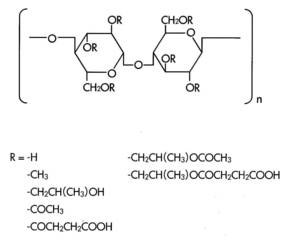
Hypromellose Acetate Succinate
Nonproprietary Names:
Hypromellose Acetate Succinate.
Synonyms:
cellulose, 2-hydroxypropyl methyl ether, acetate succinate; Hydroxypropyl Methylcellulose Acetate Succinate; HPMCAS.
Chemical Name & CAS No.
Cellulose, 2-hydroxypropylmethyl ether, acetate hydrogen butanedioate [71138-97-1]
Functional Category:
Controlled-release agent; Solubility enhancing agent; Enteric coating agent; Film-forming agent; Sustained-release agent.
Product Description:
Hypromellose acetate succinate is a mixture of acetic acid and monosuccinic acid esters of hydroxypropylmethyl cellulose. It is available in several grades, which vary in extent of substitution, mainly of acetyl and succinoyl groups, and in particle size (fine or granular). It contains 12.0–28.0% of methoxy groups; 4.0–23.0% of hydroxypropoxy groups; 2.0–16.0% of acetyl groups; and 4.0–28.0% of succinoyl groups. Hypromellose acetate succinate is a white to off-white powder or flakes. It has a faint acetic acid-like odor and a barely detectable taste. Hypromellose acetate succinate is available in several grades, according to the pH at which the polymer dissolves (low, l; medium, m; and high, h) and its predominant particle size (cohesive fine powder, f; or free-flowing granules, g).
Hypromellose acetate succinate is commonly used in oral pharmaceutical formulations as a film coating, as well as an enteric coating material for tablets or granules. It is a solubility enhancing agent via solid dispersion. Hypromellose acetate succinate is insoluble in gastric fluid but will swell and dissolve rapidly in the upper intestine. Hypromellose acetate succinate may be used alone or in combination with other soluble or insoluble binders in the preparation of granules with sustained drug-release properties; the release rate is pH-dependent. Dispersions of poorly soluble drugs with hypromellose acetate succinate are prepared using techniques such as mechanical grinding, solvent evaporation, and melt extrusion.
Solubility of Hypromellose Acetate Succinate
| Solvent System | LG | MG | HG |
|---|---|---|---|
| Acetone | Soluble | Soluble | Soluble |
| Methanol | Soluble | Soluble | Soluble |
| 10% NaOH | Soluble | Soluble | Soluble |
Stability and Handling:
Hypromellose Phthalate is packaged in 25 kg fiberboard drums equipped with double polyethylene inner liner and metal lock. Hypromellose acetate succinate should be stored in a well-closed container, in a cool, dry place. Under such storage conditions, hypromellose acetate succinate is a stable material. Hypromellose acetate succinate is hygroscopic. It is hydrolyzed to acetic acid and succinic acid; this hydrolysis is the main degradation pathway responsible for increasing amounts of free acids during storage, especially upon exposure to moisture.
Specification of Hypromellose Acetate Succinate:
| Properties | Specifications | |||
| JP | USP / NF | |||
| LG | MG | HG | ||
| Identification | I.R. Spectra | I.R. Spectra | I.R. Spectra | I.R. Spectra |
| Viscosity @ 20°C | 2.4cps – 3.6cps | 2.4cps – 3.6cps | 2.4cps – 3.6cps | 2.4cps – 3.6cps |
| Loss on Drying | NMT 5% | NMT 5% | NMT 5% | NMT 5% |
| Residue on Ignition | NMT 0.2% | NMT 0.2% | NMT 0.2% | NMT 0.2% |
| Heavy metals | NMT 10ppm | NMT 10ppm | NMT 10ppm | 0.001% |
| Free Acid | NMT 1% | NMT 1% | NMT 1% | NMT 1% |
| Methoxy Content | 20% – 24% | 21% – 25% | 22% – 26% | 12% – 28% |
| Hydroxypropxy Content | 5% – 9% | 5% – 9% | 6% – 10% | 4% – 23% |
| Acetyl Content | 5% – 9% | 7% – 11% | 10% – 14% | 2% – 16% |
| Succinoyl Content | 14% – 18% | 10% – 14% | 4% – 8% | 4% – 28% |
© 2026 G.M. Chemical. Designed by FQI. All rights reserved.